You missed a mortgage payment. Maybe two. Now you’re wondering how much time you have before the bank takes your house. It’s a scary question. But the answer might give you some relief.
Foreclosure in Maryland is not fast. It’s not automatic either. There are steps, deadlines, and chances for you to act along the way. This guide breaks down exactly how the process works, month by month, so you know where you stand.
The Short Answer
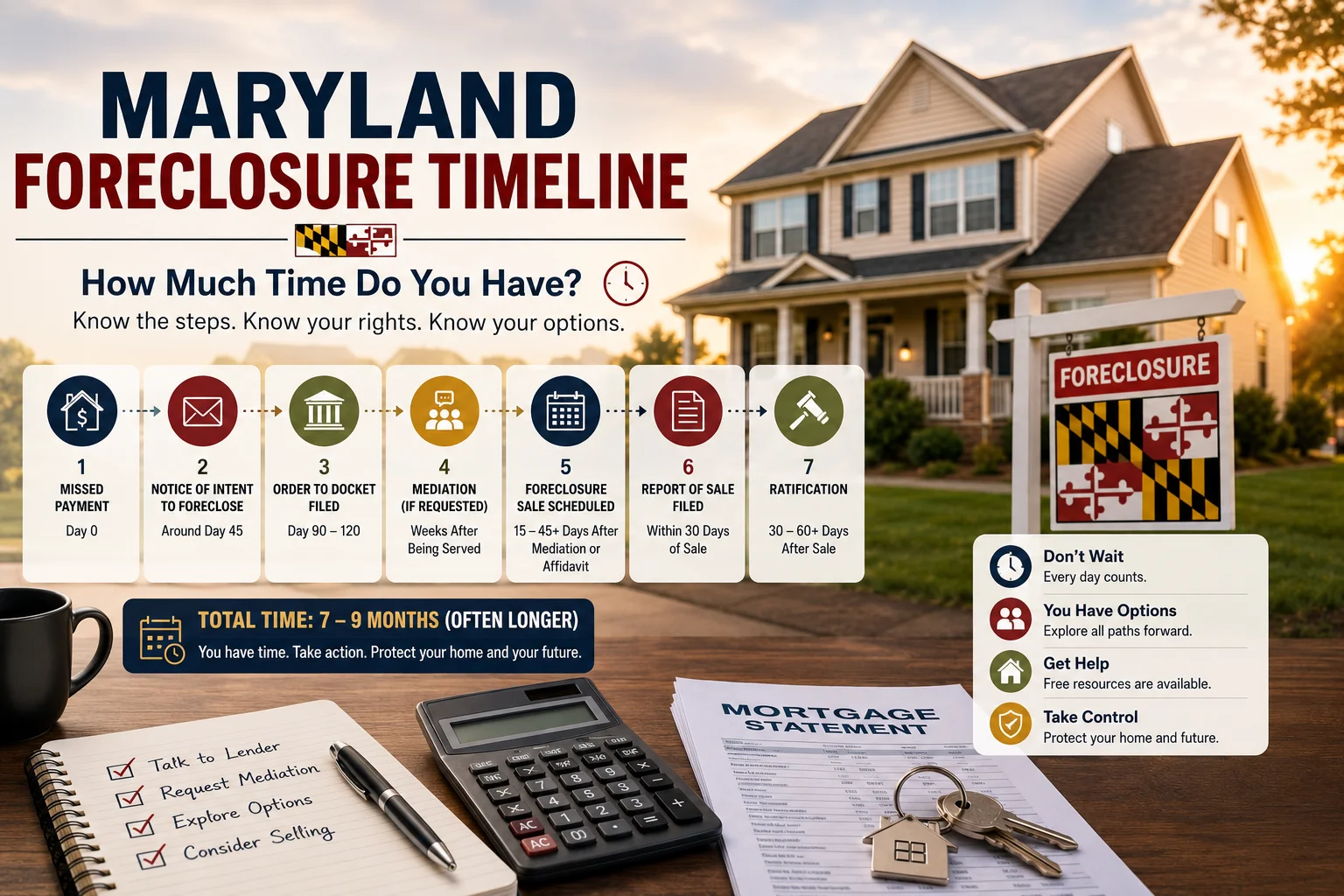
Most Maryland foreclosures take about 7 to 9 months from the first missed payment to a completed sale. Many take longer. If there’s mediation, court delays, or you file a legal motion, the process can stretch to 12 months or more.
That means you almost always have time. Time to catch up, time to negotiate, or time to sell before it’s too late.
Step-by-Step: What Actually Happens
Step 1: You Miss a Payment (Day 0)
This is where the clock starts. One missed payment on its own won’t trigger foreclosure. But it starts a chain of deadlines your lender has to follow.
Step 2: Notice of Intent to Foreclose (Around Day 45)
Your lender must send you a formal notice before they can take any court action. This notice has to include information about loss mitigation and mediation. It typically goes out about 45 days after your first missed payment.
This is your first real warning sign. Don’t ignore it. It’s also your first real chance to act.
Step 3: Order to Docket Filed (Day 90 to 120)
This is the official start of the legal process. Your lender’s law firm files what’s called an Order to Docket with the court. It cannot be filed sooner than 90 days after your first missed payment, and for most loans, it’s actually 120 days.
You’ll be formally served with this filing. It includes a Loss Mitigation Affidavit, which is either preliminary (if your lender hasn’t finished reviewing your options) or final (if they have).
Step 4: Mediation (If You Request It)
Here’s something a lot of homeowners don’t know: you have the right to request mediation. This gives you a chance to sit down with your lender, with a neutral third party from the Office of Administrative Hearings, and talk through options like a loan modification or repayment plan.
You have to request this within a set deadline after being served, so don’t sit on it.
Step 5: Foreclosure Sale Scheduled
If mediation doesn’t lead to an agreement, or if you don’t request mediation, your lender can schedule a sale date. This can happen as soon as 15 days after mediation, or 45 days after you’re served with a Final Loss Mitigation Affidavit if there was no mediation.
Important: even at this stage, you still have the right to “cure” the default. That means paying everything you owe, including fees, up until one business day before the sale. Do that, and the foreclosure stops.
Step 6: The Sale
The property is sold, usually at auction. This is the point most people think of as “losing the house.” But even after this, the process isn’t fully over.
Step 7: Ratification (30 to 60+ Days After Sale)
The lender has to file a Report of Sale with the court within 30 days. The court then gives notice that it plans to ratify, or officially confirm, the sale. You have a window to file exceptions if something about the sale wasn’t handled properly.
Once the court ratifies the sale, ownership officially transfers. This last stage can add another month or two to the total timeline.
Full Timeline at a Glance
| Stage | When It Happens |
|---|---|
| First missed payment | Day 0 |
| Notice of Intent to Foreclose | Around Day 45 |
| Order to Docket filed | Day 90–120 |
| Mediation (if requested) | Weeks after being served |
| Foreclosure sale | 15–45+ days after mediation or affidavit |
| Report of Sale filed | Within 30 days of sale |
| Ratification | 30–60+ days after sale |
| Total (typical) | 7–9 months, often longer |
What Can Make the Timeline Longer
Several things can push this process well past 9 months:
- Requesting mediation
- Filing a motion to stay or dismiss the case
- Delays in the court system
- Your lender’s own processing delays
- Ongoing loss mitigation review
None of these are bad things to use. They exist to protect you. Just know they add time, not take it away.
What You Should Do With This Time
Knowing your timeline is only useful if you use it. Here’s what that looks like in practice:
- Talk to your lender immediately. Don’t wait for the Notice of Intent to Foreclose to show up.
- Request mediation if you’re not sure what to do. It’s free, and it keeps your options open.
- Talk to a HUD-approved housing counselor. This service is free and works entirely in your interest.
- Decide early if keeping the house is realistic. If it’s not, selling before the sale date protects your credit and any equity you’ve built.
A Real Example
James fell behind on his mortgage in Anne Arundel County after a medical emergency drained his savings. He got the Notice of Intent to Foreclose and panicked, assuming he’d lose the house within weeks.
Instead, he requested mediation, which pushed things out several more months. During that time, he explored his options and realized a loan modification wouldn’t get his payment low enough. He sold his home for cash before the sale date, paid off the mortgage, and walked away with the remaining equity instead of losing it all in foreclosure.
Conclusion
Foreclosure in Maryland isn’t instant, and it isn’t automatic. From your first missed payment to a finalized sale, you’re usually looking at 7 to 9 months, and often more. That’s real time. Time to talk to your lender, time to request mediation, time to explore your options, or time to sell on your own terms.
The worst move is doing nothing. Every step in this process gives you a chance to change the outcome. Take it.
Facing Foreclosure? Let’s Talk About Your Options
If you’re behind on your mortgage anywhere in Maryland and you’re not sure what to do next, we can help. Next Step Equity Group works with homeowners at every stage of this process, from a first missed payment to a scheduled sale date. We’ll give you a fair, no-obligation cash offer and explain exactly where you stand, with zero pressure.
Call us at (443) 278-0407 or reach out online for a free consultation today.
FAQs
Q: How long does foreclosure take in Maryland? Most cases take about 7 to 9 months from the first missed payment to a completed sale. With mediation or legal motions, it can take 12 months or longer.
Q: Is Maryland a judicial foreclosure state? Most Maryland foreclosures are non-judicial, though a court does file and oversee parts of the process. This is sometimes called a “quasi-judicial” foreclosure.
Q: Can I stop foreclosure after the sale date is scheduled? Yes, up until one business day before the sale, you can “cure” the default by paying everything owed. You can also sell the home before the sale date.
Q: Do I have to go through mediation? No, mediation is optional. But it’s free, and it can slow down the process while you weigh your options.
Q: What happens if I do nothing? The foreclosure process continues on its own timeline, and you lose chances to negotiate, modify your loan, or sell on your own terms.
Q: Can I sell my house during any stage of foreclosure? Yes. You can sell at any point before the sale is finalized and ratified by the court.